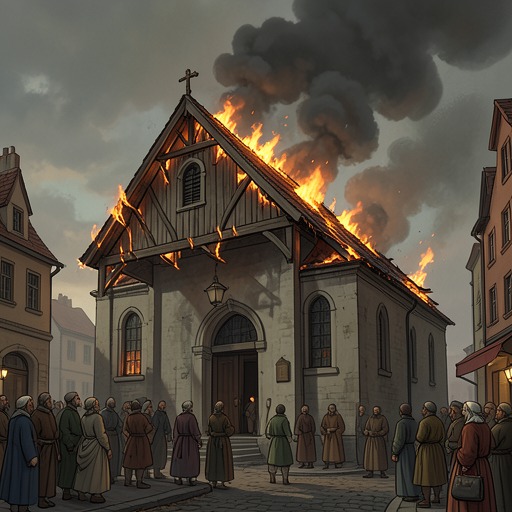
Holmenkollen Chapel
Lords of ChaosHolmenkollen Chapel, in Oslo, became one of the most consequential sites in the Norwegian Black Metal church arsons: it was burned to the ground, and the city later sued Varg Vikernes for damages. The account presents the chapel not only as a destroyed building but as a focal point where criminal action, subcultural spectacle, and the material consequences of arson converged.
The chapel and the arson
Holmenkollen Chapel was among the churches targeted during the escalating arson attacks associated with the Black Metal scene. In Varg Vikernes’s later account, the chapel burned to the ground after another church in Bergen had been set alight, though he also recalled an earlier Bergen fire that had failed to spread and gone unreported. He named Holmenkollen, Skjold Church, and Åsane Church as the three successful burnings for which he was found guilty, and identified a separate unsuccessful attempt.
The chapel’s destruction also appears in the account of Bård Eithun’s actions. After the killing of Magne Andreassen, Eithun participated in the Holmenkollen arson the following day, together with Vikernes and Øystein Aarseth. In an interview, Eithun recalled that after setting the church alight, the group rode up the mountain to watch it burn, then returned to the record store unable to sleep. The episode places the chapel within a sequence in which a serious crime was followed immediately by another act of destruction, without an apparent interruption by police consequences.
A scene made visible through destruction
The fire acquired meaning beyond the loss of the building. One participant recalled first hearing about church burnings in the news, then meeting Vikernes, who announced that he had burned a church and showed photographs. The photographs made the act tangible to others in the scene, while its perceived shock value and association with anti-Christian ideas helped it circulate as an example to emulate.
The response was described as collective and personal: people wanted to do something similar, and the destruction became a shared creation around which participants felt a strong sense of brotherhood and opposition to outsiders. That recollection does not establish that every arsonist had the same motive. The interview distinguishes attacks intended as symbols against Christianity from acts meant to prove commitment to senior figures, or simply to demonstrate badness. Holmenkollen’s burning belongs to this broader atmosphere of imitation, status-seeking, and transgression, rather than to a single, uniform explanation.
Legal and material consequences
The city of Oslo brought a civil claim against Vikernes to recover damages for the burning of Holmenkollen Chapel. The original demand sought compensation for the full rebuilding costs of the churches involved, a total described as nearly 40 million kroner. The amount was later reduced to exclude the costs of consecrating rebuilt churches and holding cake parties. Around 37 million kroner nevertheless remained in dispute, and Vikernes rejected the charges, requiring the matter to proceed through the courts again.
Those figures concern rebuilding the churches collectively, not a separate valuation of Holmenkollen Chapel alone. The book also sets the case against the larger expense of reconstructing totally destroyed Norwegian churches, estimated by the Directorate for Cultural Heritage at 15 to 30 million kroner each. The chapel’s destruction thus carried a financial aftermath on a scale far removed from the perpetrators’ immediate experience of watching the fire.
Place in the account
Holmenkollen Chapel recurs in two sharply different registers: as a building reduced to ruins and as a dramatic image within the Black Metal scene. The account of the fire foregrounds its spectacle for those involved; the civil proceedings return attention to reconstruction costs and the city’s effort to recover them. Together, those perspectives make the chapel a concrete measure of the distance between the scene’s rhetoric of transgression and the lasting damage left behind.